

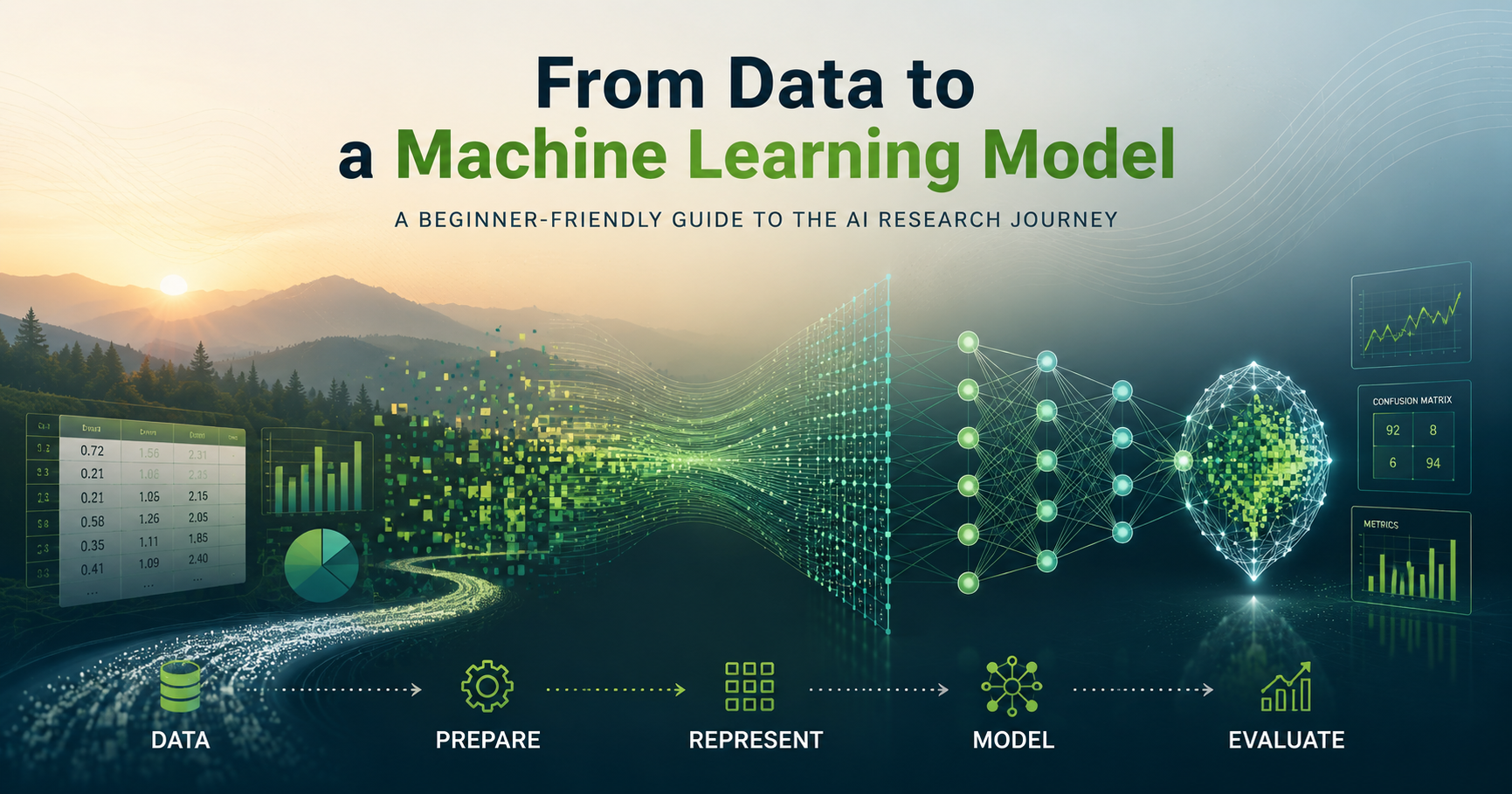
What does it mean to “build a model”?
A machine learning model is a computational system that learns patterns from examples. Instead of manually writing every rule, we provide data and allow an algorithm to learn a useful mapping between inputs and outputs.
What goes into the model?
Images, text, numerical measurements, audio, graphs, or combinations of different data types.
What should it learn?
A class, value, location, segmentation mask, ranking, or another research target.
What pattern should it discover?
The model learns relationships between input information and the target using training examples.
Does it actually work?
We test the model using data and evaluation methods appropriate for the research question.
The journey from raw data to a model
A useful way to understand AI research is to think of model development as a pipeline. Each stage prepares the project for the next one.
Define the research problem
Start with a question, not a model. What problem are you trying to solve? What is the expected output? Why does solving this problem matter?
Find or collect the data
Identify a suitable dataset or collect data according to a clearly defined research protocol.
Understand the dataset
Inspect distributions, missing values, duplicates, labels, imbalance, and potential quality problems.
Prepare the data
Clean, transform, normalize, resize, tokenize, or otherwise preprocess the data according to the task.
Create the experimental split
Separate training, validation, and test data carefully. The splitting strategy must prevent information leakage.
Build a baseline
Establish a credible baseline before introducing a complicated proposed architecture.
Select or design the model
Choose an architecture appropriate for the data and research question.
Train and experiment
Train the model, monitor experiments, and systematically investigate how configurations affect performance.
Evaluate the model
Select metrics that match the research objective and evaluate using an appropriate validation strategy.
Analyze failures and improve
Study errors, weaknesses, robustness, and generalization rather than relying on a single score.
Step 1: Start with the data
Data is the foundation of a machine learning project. A sophisticated model cannot compensate for a fundamentally unsuitable dataset.
Before asking “Which model should I use?”, ask “What exactly does my data contain?”
Questions to ask about your dataset
- How many samples are available?
- What does one sample represent?
- What are the input features?
- What is the target variable?
- Are labels reliable?
- Are there missing or duplicate records?
- Is the dataset balanced?
- Could there be data leakage?
Beginner note: What is a feature?
A feature is information that the model can use to make a prediction. In tabular data, a feature could be age, income, or temperature. For an image, the information is represented through pixels and learned visual features.
Step 2: Prepare the data
Raw research data is rarely ready to enter a model directly. Preprocessing converts the original data into a form that the learning algorithm can use effectively.
Numerical data
Cleaning, encoding, scaling, imputation, and feature preparation may be required.
Computer Vision
Resizing, normalization, augmentation, and annotation may become important.
Natural Language Processing
Tokenization, normalization, and model-specific input preparation are common steps.
Speech and audio
Audio can require sampling, segmentation, feature extraction, or representation learning.
Step 3: Split the data correctly
One of the most important decisions in machine learning research is determining how the available data will be used for training and evaluation.
Never allow information from the evaluation set to influence the training process.
| Split | Purpose | Typical role |
|---|---|---|
| Training | Learn model parameters | Model fitting |
| Validation | Guide development decisions | Model selection and tuning |
| Test | Estimate final generalization | Final evaluation |
Step 4: Build a baseline before inventing a model
A common beginner mistake is to immediately design a complicated architecture. Research usually becomes stronger when a simple baseline is established first.
The baseline gives you something to compare against. Without a credible baseline, it becomes difficult to determine whether your proposed method actually provides an improvement.
Beginner note: What is a baseline?
A baseline is a reference method. It can be a simple machine learning algorithm, a standard deep learning architecture, or another established approach appropriate for the research problem.
Step 5: From data representation to model
Once the research problem, dataset, and experimental design are understood, the next question is how the information should be represented and processed by a model.
Input representation
Determine how the raw information will enter the learning system.
Feature representation
The model learns or receives representations that capture useful information from the input.
Prediction layer
The model converts its learned representation into the required output.
Loss function
During training, the loss measures how different the prediction is from the desired target.
Optimization
An optimizer updates model parameters so the model can progressively improve the training objective.
Step 6: Train the model
Training is the process through which the model learns from the training data. Researchers run controlled experiments and learn from the resulting evidence.
- Choose an appropriate model configuration.
- Define the training objective.
- Select an optimizer.
- Train using the training data.
- Monitor validation performance.
- Record the experiment configuration and results.
One experiment gives you a result. A series of controlled experiments gives you evidence.
Step 7: Evaluate more than one number
Evaluation should be connected to the research question. The correct metric depends on the task, data distribution, and decision objective.
Classification metrics
Accuracy, precision, recall, F1-score, ROC-AUC, PR-AUC, and MCC can provide complementary evidence.
Regression metrics
MAE, MSE, RMSE, and R² measure different aspects of prediction error.
Validation
Cross-validation, confidence intervals, and calibration can provide evidence beyond a single score.
Error analysis
Examine where the model fails and whether those failures reveal weaknesses in the methodology.
Step 8: When does a model become a research contribution?
Building a model and conducting research are not exactly the same thing. A research contribution requires clear motivation, methodological reasoning, and evidence.
Do not ask only “Is my model accurate?” Ask “Why does this method work, where does it fail, and what does the evidence tell us?”
This is where comparative evaluation, ablation studies, robustness analysis, and error analysis become important.
Putting everything together
The complete AI/ML research workflow can now be viewed as one connected process.
Research question
Define what you want to investigate.
Data
Find, collect, and understand appropriate evidence.
Preparation
Clean, transform, and organize the data.
Baseline
Establish a credible reference point.
Model
Choose or develop an appropriate methodology.
Experiments
Run controlled experiments and record evidence.
Evaluation
Measure performance and analyze reliability.
Research contribution
Explain what the study contributes and why it matters.
The key idea
A strong AI/ML research project is not simply “dataset + model + accuracy”. It is a connected process where the research question, dataset, methodology, experiments, and evaluation all support the scientific claim.
Learn the complete AI/ML research workflow
AMIR Academy's AI & Machine Learning Research Bootcamp takes learners through research foundations, literature review, dataset development, AI/ML experimentation, proposed model development, evaluation, scientific writing, and publication.
Explore AMIR Academy
Discussion
Start the conversation
No comments yet. Be the first.